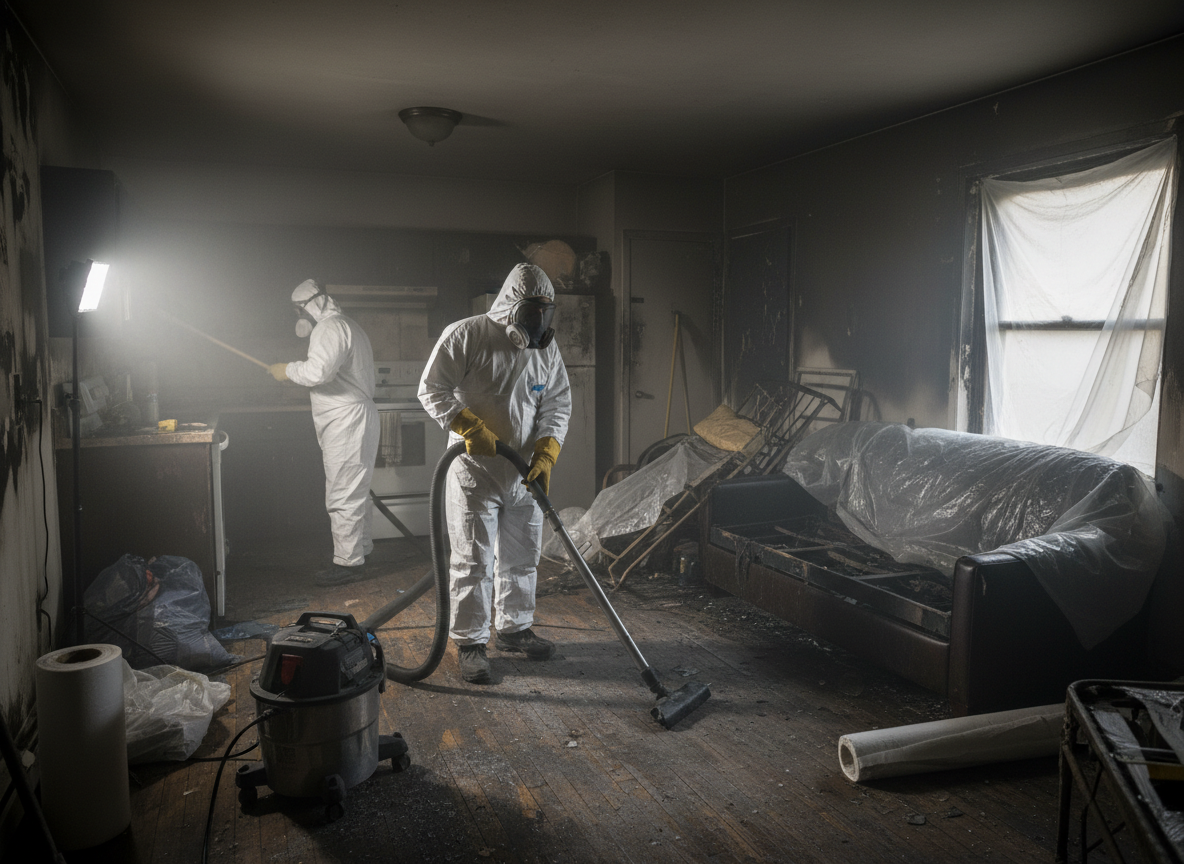
Tenant fire damage cleanup in Edison often involves older single-family homes and mobile units built along Edison Highway that lack modern vapor barriers. Smoke from kitchen or electrical fires travels through unsealed attics and wall cavities during the hot, arid summers when windows stay closed, leaving acidic soot on drywall, cabinets, and HVAC registers. Technicians must test pH levels on surfaces before neutralization because the dry San Joaquin Valley air allows residue to remain corrosive longer than in coastal climates. Failure to address hidden deposits behind baseboards or in return ducts leads to recurring odors once mild winter rains raise indoor humidity.
Cleanup crews start by isolating the affected unit from shared walls common in Edison rentals near Bakersfield. HEPA air scrubbers run continuously while porous materials such as carpet padding and acoustic ceiling tiles are removed to prevent re-soiling. In properties with evaporative coolers, the water lines and pads require separate decontamination because soot mixes with mineral scale and spreads through the system. Landlords receive photo documentation at each stage to satisfy insurance adjusters who frequently question tenant-caused damage versus preexisting wear in agricultural worker housing.
Final clearance testing measures airborne particulates and surface residue before tenants can reoccupy. Because Edison experiences temperature swings between daytime heat and cooler nights, crews reseal duct joints with mastic rather than tape to stop future smoke migration. Odor counteractants are applied only after source removal, avoiding masking that fails once windows open again in spring. This sequence keeps the unit compliant with Kern County habitability standards without unnecessary demolition.
Technician insight
In Edison, the thing that catches most people out with tenant fire damage cleanup is how the dry San Joaquin Valley air and older loose-fill insulation in homes along Edison Highway let smoke travel into wall cavities and evaporative cooler ducts that landlords forget to check, turning a small kitchen fire into full-system work.
Kitchen Fire Spread in Edison Rental
Soot from a stove fire moved through an unsealed attic in a 1980s Edison house. We found residue inside the evaporative cooler and return ducts due to the arid conditions. We contained the unit, removed affected insulation, cleaned the HVAC, and cleared the property for re-rental.
How it works
- 1
Site Assessment
Technicians inspect all rooms, attic spaces, and HVAC systems to map smoke migration paths in the specific Edison rental.
- 2
Containment Setup
Plastic barriers and negative air machines isolate the fire area from adjacent units common along Edison Highway.
- 3
Soot Removal
Dry and wet cleaning methods remove residue from hard surfaces while discarding contaminated porous materials.
- 4
HVAC and Odor Treatment
Ducts are cleaned and treated; air scrubbers run until readings meet clearance standards for reoccupancy.
- 5
Final Documentation
Photos and test results are provided to the property owner for insurance and tenant move-in records.
Pricing
Upfront quotes after on-site inspection; cost varies with square footage, smoke travel distance, and HVAC involvement.